Here's a secret experienced golfers won't tell you: nobody cares if you shoot 120. Not the starter, not the group behind you, not the low-handicapper you got paired with. What they care about — the entire social contract of golf — comes down to four things: keep moving, keep quiet at the right moments, keep everyone safe, and leave the course better than you found it. Master those and you'll be welcome in any foursome in the world, whatever your score says. This golf etiquette guide covers exactly that, with none of the country-club mystique.
Rule Zero: Pace Beats Everything
If you remember one thing, remember this: slow play is the only etiquette sin golfers genuinely resent. Every other mistake gets forgiven instantly when you're a beginner. Taking eight minutes per shot does not.
The good news: pace has almost nothing to do with skill. A beginner who plays fast is better company than a scratch golfer who plays slow. Here's how:
- Be ready when it's your turn. Do your thinking — club choice, target, practice swing — while others hit. This is called "ready golf" and it's the modern standard.
- Cap your search time. The rules give you three minutes to find a lost ball. As a beginner, give it ninety seconds, drop another ball, and move on.
- Pick up when you're out of the hole. In casual golf, once you've hit double par (an 8 on a par 4), pick up the ball, write down the max, and enjoy the walk. Nobody objects. Everybody appreciates it.
- Park smart. Leave your bag or cart on the side of the green toward the next tee, so you exit in the direction you're heading.
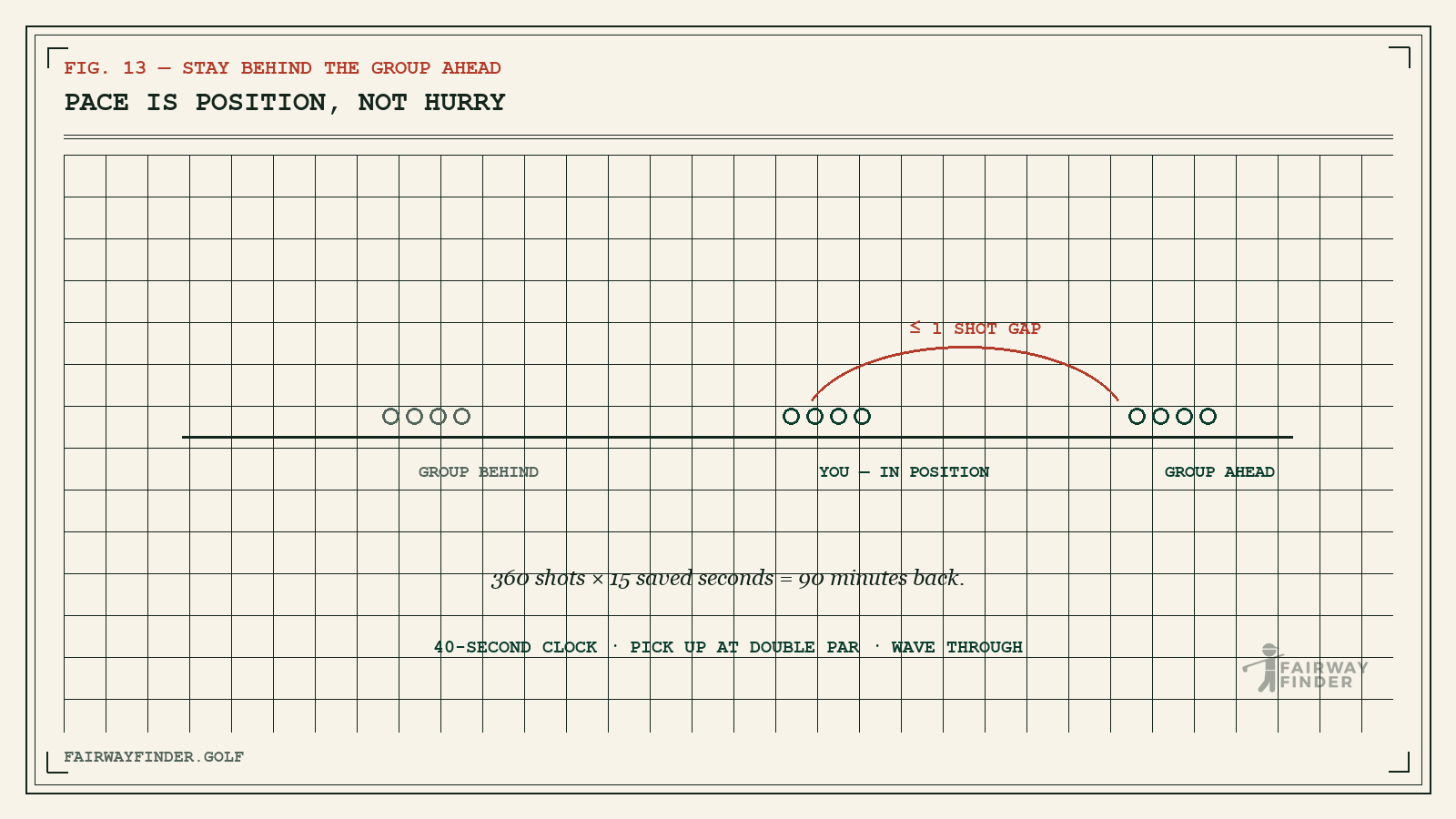
The measure isn't your total time — it's staying in position: your group should be roughly one shot behind the group in front, not one hole ahead of the group behind.
Quiet and Stillness: When It Actually Matters
Golf's silence rule gets exaggerated into parody. You can talk, laugh, and needle your buddies for four hours — that's half the point of the game. The quiet window is small and specific: from the moment a player starts their pre-shot routine until the ball is gone.
During that window:
- Stand still. Peripheral movement is more distracting than noise.
- Stand where they can't see you — behind or across, never on the line of the shot or directly behind the hole on the green.
- Silence the phone. A ringtone mid-backswing is the fastest way to make an enemy for eighteen holes.
That's it. Between shots, golf is a social game. Anyone who demands library silence for four hours is the one violating etiquette.
Safety: The Non-Negotiable One
A golf ball leaves the face at over 100 mph. The two absolute rules:
- Never hit until the group ahead is clearly out of range. When in doubt, wait. No one has ever regretted waiting.
- Yell "FORE!" — loud, immediately, no embarrassment — the instant your ball flies toward anyone. Every golfer who's played a year has yelled it. Staying silent to save face is the one genuinely unforgivable move on a golf course.
And on the tee, stand level with or behind the player hitting, never ahead.
Course Care: The Three-Second Habits
Every golfer inherits the course from the group before and hands it to the group after. Three habits, three seconds each:
- Replace or fill your divots in the fairway (sand bottle on the cart, or fold the turf back).
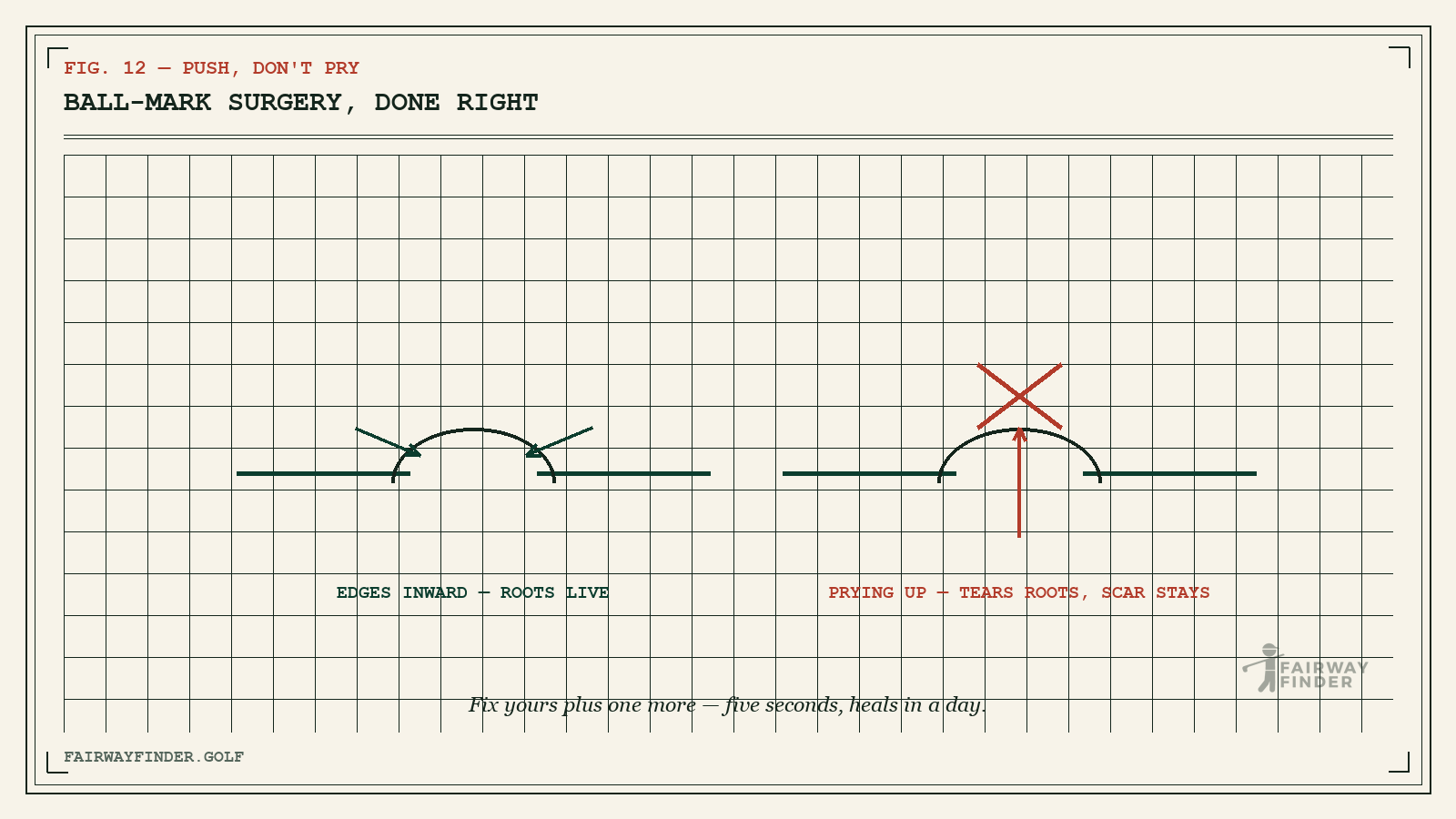
- Fix your ball mark on the green — plus one more you find. Push the edges toward the center; don't lift.
- Rake the bunker after your escape, and enter from the low side, never down the steep face.
There's a full deep-dive in our guide to divots, ball marks and bunker care, because this is the area where new golfers most want specifics.
On the Green
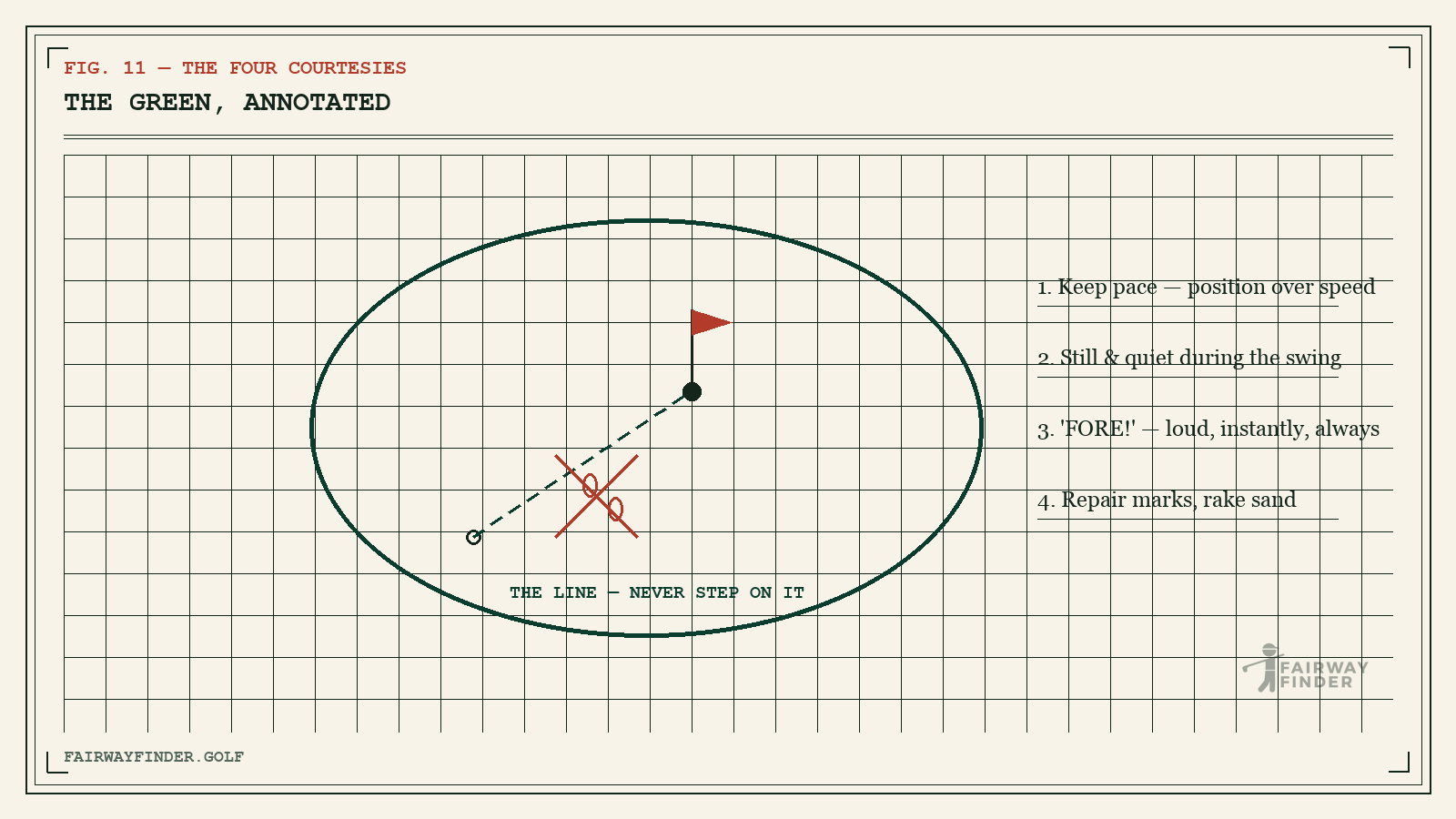
The green has its own micro-etiquette, and it's mostly about the invisible line between every ball and the hole:
- Don't step on anyone's line (the path their putt will travel). Walk around.
- Don't stand directly behind a player's line while they putt.
- The player farthest from the hole goes first — though in casual play, whoever's ready putts.
- Tend or remove the flagstick if asked. Since the rules changed in 2019, leaving the pin in while putting is completely legal — a lot of older golfers still haven't caught up on that one.
Cart and Clubhouse Basics
- Follow the day's cart rules: "cart path only" means it, and the 90-degree rule means cross the fairway at a right angle, then return to the path.
- Never drive within about 30 feet of greens, tees, or bunkers.
- Hats off (traditionally) and handshakes or fist bumps on the 18th green — win, lose, or 120.
What You Don't Need to Worry About
For balance, here's the outdated stuff no reasonable course enforces on a beginner: perfect creases, tucked shirts at the muni, knowing every rule number, playing "honors" order off every tee in a casual round, or apologizing after every mishit. Say "my bad" once if it's slow, fix what you dented, and keep walking.
Golf etiquette isn't a hazing ritual — it's just the operating system that lets four strangers share a field with flying projectiles and still enjoy themselves. Keep pace, stay safe, respect the quiet window, repair your marks. Do those four things and you belong out there, from your very first round. If you're gearing up for that round, read our step-by-step first round survival guide next.
Ready to find more fairways?
The Fairway Finder driver — 43.5" control length, 460cc titanium, 11° high launch, oversize leather grip. $299 USD / CA$399 with headcover and 1-year warranty.