Golf courses are the only sports venues maintained partly by the players mid-game. Every group inherits the course from the group ahead and hands it to the group behind — and the whole system runs on three tiny skills that, weirdly, nobody formally teaches: fixing ball marks, handling divots, and raking bunkers. Most golfers do at least one of them wrong (usually the ball mark). Here's course care done correctly, once and for all.
Ball Marks: The One Everyone Fixes Wrong
When your approach shot lands on a soft green, it stamps a small crater — a ball mark (or pitch mark). Unrepaired, the compressed grass dies and leaves a scar that takes weeks to heal and deflects everyone's putts until it does. Repaired within minutes, it heals in a day or two.
The correct technique — and this is the part most golfers get backwards:
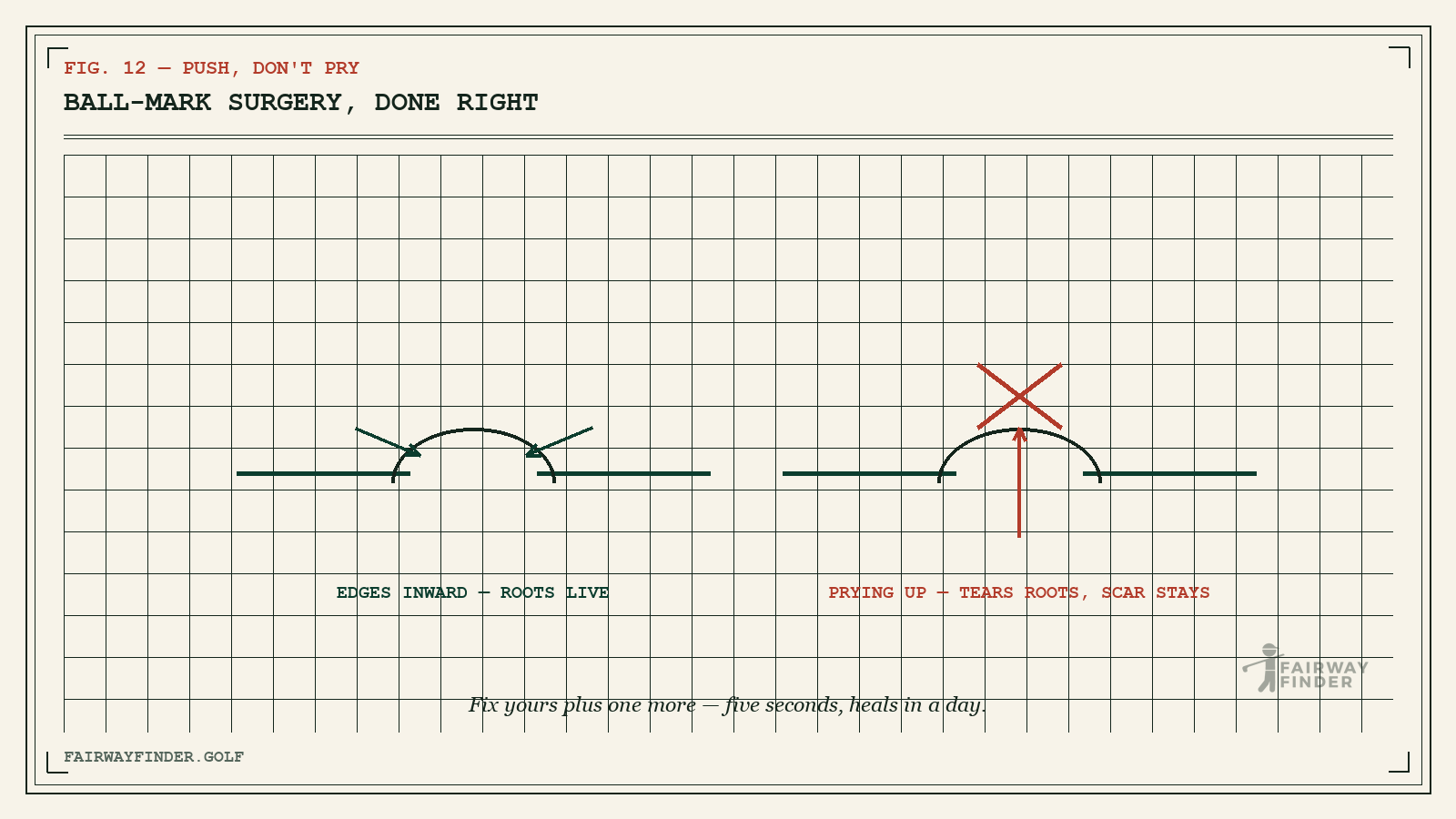
- Insert your repair tool (or a tee) at the edges of the crater, angled toward its center.
- Push the surrounding turf sideways/inward, working around the rim, closing the hole like a drawstring.
- Never lever upward. Prying the bottom of the crater up feels satisfying and looks fixed — but it tears the roots, and that "fixed" mark dies anyway. Push in, don't pop up.
- Tamp flat with your putter sole. Done — five seconds.
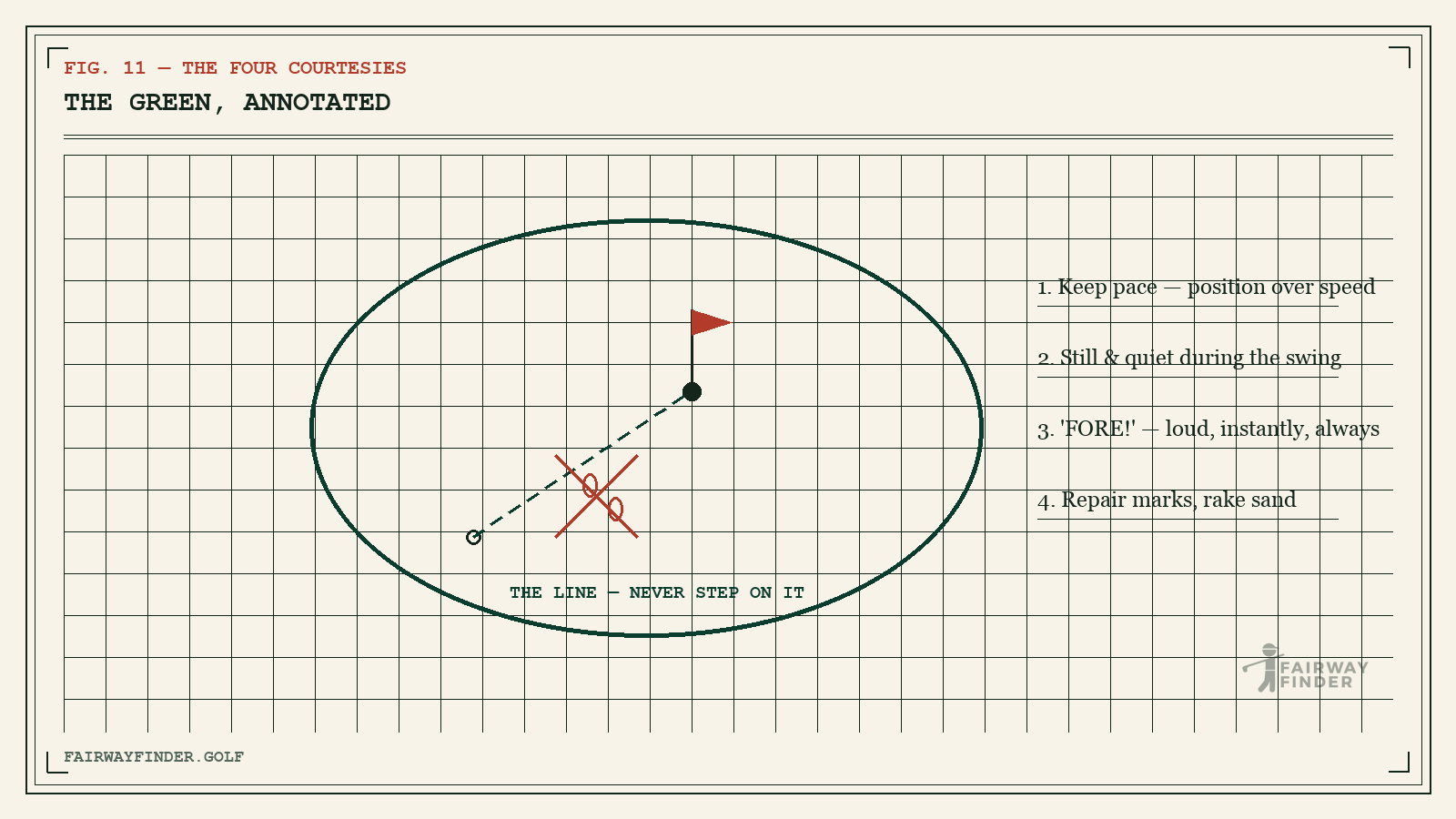
The etiquette standard: fix yours plus one more you find. If every golfer did that, greens would be perfect by dinner. On busy public courses, be the person the greenkeeper doesn't know exists.
Divots: Replace or Fill? (It Depends on the Grass)
A divot is the pelt of turf your iron shears off in the fairway — a sign of a proper strike, nothing to apologize for. The repair rule confuses people because the correct move genuinely varies:
- If the divot came out as one intact strip or flap (common on cool-season grasses like bent and rye, i.e., most northern courses): retrieve it, lay it back in place root-side down, and step on it firmly. Reunited turf re-roots remarkably well.
- If it exploded into confetti (typical of warm-season Bermuda grass in the South, whose runners regrow laterally anyway): fill the hole with the sand/seed mix from the bottle on your cart or the containers by the tees. Level it flush — a mounded fill is as bad as a hole for the next player's lie.
- Cart has no sand, divot's in pieces? Kick in the edges, tamp, move on. Imperfect care beats none.
On tees (especially par 3s), use the sand mix rather than replacing — tee divots are shallow and sand levels the launch pad best.
Bunkers: Enter Low, Rake Backward, Leave It Boring
Bunker care errors are mostly entry-and-exit errors:
- Enter and exit from the low side, never down the steep face — climbing the face collapses the edge and leaves footprint craters no rake fully fixes.
- After your shot, rake everything you disturbed: your splash crater, your footprints, the path you walked. Pull the rake toward you as you retreat to the low edge, then smooth the final steps out backward.
- Finish flat and dull. Fancy furrow patterns are for TV tournaments; club golfers just want no craters.
- Leave the rake where the course wants it — the local convention is whatever the other bunkers show: fully inside, or outside laid parallel to play. Match what you see. (Either way: teeth down.)
One rules note that surprises people: since 2019 you may legally remove leaves, stones, and other loose impediments from a bunker before your shot. The old "touch nothing" terror is outdated — you just still can't test the sand or ground your club right behind the ball.
The Rest of the Ledger
Smaller debts every golfer owes the course:
- Tend the turf edges: don't take practice-swing divots on tees or in fairways (take them in the rough if you must rehearse the strike).
- Carts: obey the day's rule, stay 30 feet from greens and tees, never cross between a bunker and its green.
- Trash and cigar butts leave with you; bottles go in the cart's holder, not the fescue.
- Flagstick: lay it down gently on the fringe (not dropped on the green), and replace it seated fully upright — a leaning stick rejects putts for the next group.
- Pull carts and bags stay off tees, greens, and collars entirely.
Why Bother (Beyond Virtue)
Three selfish reasons. First, course care is the most visible skill in golf — a beginner who repairs marks properly reads as a golfer instantly, regardless of score; it buys more credibility with a random pairing than any drive you'll hit (only pace of play matters more, and we've covered that playbook too). Second, you putt on the greens you and everyone else repaired — the karma is same-day. Third, greenkeepers notice groups, and being on the staff's good side at your home course pays off in a hundred small ways.
Three habits, three seconds each: push the ball mark inward, lay the divot back or sand it flush, rake your way out backward. That's the entire tuition for golf's oldest club — the people who leave the course better than they found it. For the rest of the unwritten rulebook, start with our complete beginner's etiquette guide.
Ready to find more fairways?
The Fairway Finder driver — 43.5" control length, 460cc titanium, 11° high launch, oversize leather grip. $299 USD / CA$399 with headcover and 1-year warranty.