There's a quiet epidemic on golf courses: most golfers play tees that are one or two sets too long for them, grinding through 440-yard par 4s they can't reach in three, wondering why golf feels like a siege. It comes from an outdated macho default — "real golfers play the tips" — that survives on vibes alone. Here's the modern answer to which tees you should play, and why moving forward is the single fastest way to enjoy this game more.
The Old Way (and Why It's Broken)
The traditional system assigned tees by identity: back tees for good men, middles for average men, forwards for seniors and women. That framing is obsolete twice over — it ignores that distance, not gender or age, is what matters, and it shames people into distances that ruin their scorecards. A 240-yard-drive woman and a 240-yard-drive man belong on the same tees. A 180-yard-drive man playing 6,800 yards is not being brave; he's being mathematically punished for four hours.
Color codes make it worse: there is no universal standard. One course's blue is another's white is another's gold. Ignore the colors entirely and use the numbers.
The Modern Method: Multiply Your Driver
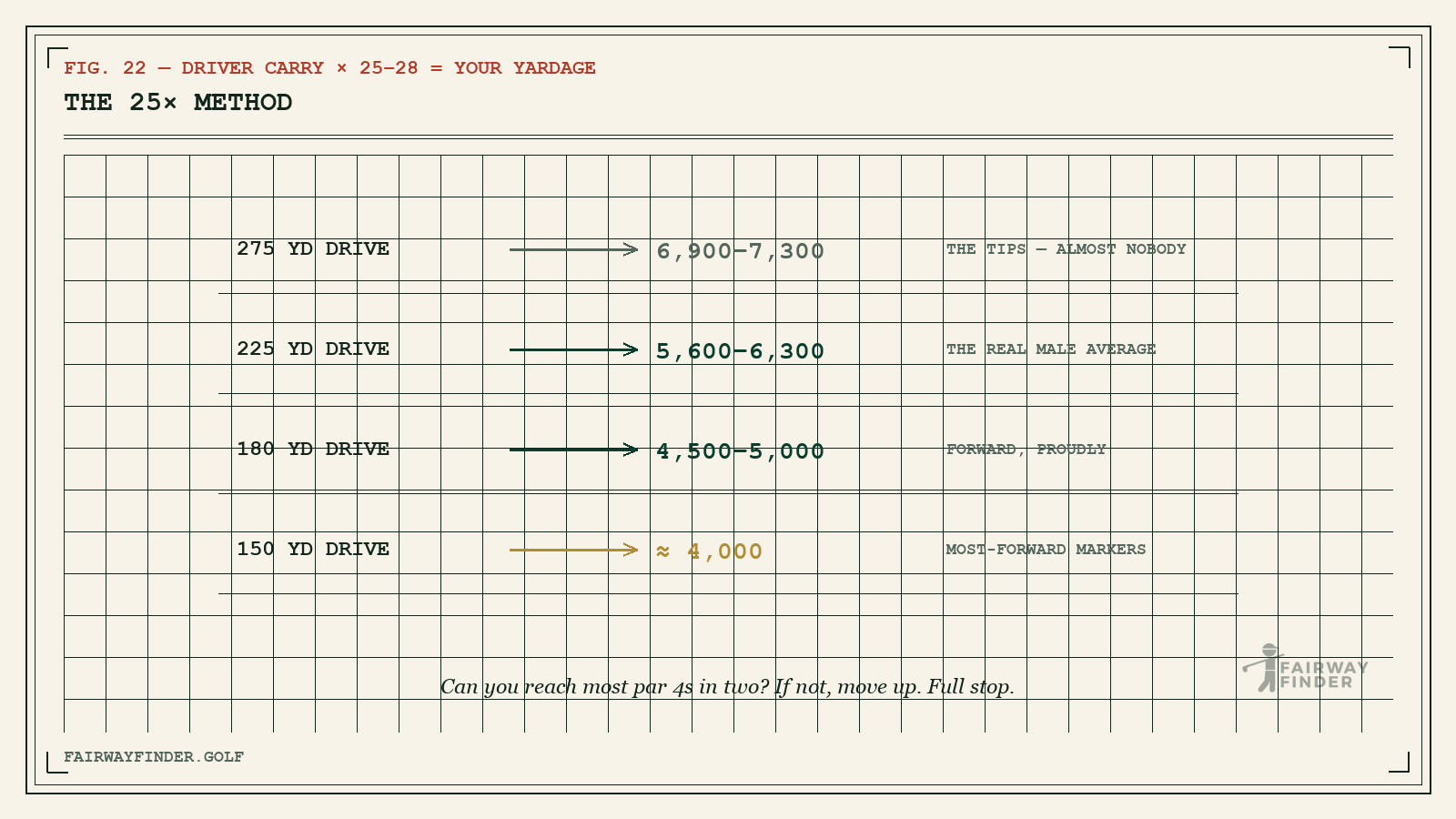
The simplest evidence-based guideline, promoted by the industry's own "play it forward" initiatives: take your average driver carry-and-roll and multiply by 25–28. That's your ideal course yardage.
- Drive it 275? → ~6,900–7,300 yards. (This is who the tips are for. It's almost nobody.)
- Drive it 225 — the actual male amateur average? → ~5,600–6,300 yards. At most courses, that's the middle or even middle-forward tees, NOT the ones most men stand on.
- Drive it 180? → ~4,500–5,000 yards. Forward tees, proudly.
- New golfer, drives around 150? → the most forward tees on the card, and the game will finally resemble the one on TV: reachable holes, real pars, actual fun.
A cross-check that works without any math: can you reach most par 4s in two shots on a good day? If not, you're too far back. Full stop.
What Moving Up Actually Does
Golfers resist playing forward because it feels like an admission. Here's what it actually is, measured:
- Approach shots become approach shots. Instead of hitting hybrid into every green (low, unstoppable, hard to hold), you hit 8-irons — the clubs that fly high, land soft, and make golf feel skillful.
- Scores drop immediately — typically 3 to 6 strokes just from the tee change, before any improvement.
- Rounds speed up for you and everyone behind you. Shorter course, fewer lost balls, fewer punch-outs.
- The architecture reveals itself. Course designers place bunkers and angles assuming certain landing zones; from too far back you never even reach the design. Playing forward puts you in the golf course instead of short of it.
And the confession no one makes: nobody in your group knows or cares which markers you teed from after the second hole. The scorecard doesn't have an asterisk column.
The Mixed-Tees Move (Advanced Modern Thinking)
Nothing requires a group to play the same tees — handicaps adjust for it automatically (the rating-and-slope machinery in our handicap explainer handles cross-tee games natively). The long hitter plays 6,600, you play 5,800, the match is still dead fair. Some courses now even print "combo" tee lines mixing two sets for in-between yardages. Use them.
If you want one round that will change your mind forever: play one full round from the most forward tees on the card. Par threes you can attack, par fives you can reach. It recalibrates what golf is supposed to feel like — and most golfers immediately settle one set further forward than their old default.
Tee Choice and Your Driver Are the Same Decision
Here's the connective tissue most golfers miss: choosing shorter tees and choosing accuracy-first equipment are the same philosophy — trading theoretical maximums you never hit for real positions you play from every hole. The golfer who moves up a tee box and games a control-length driver has made the same smart trade twice: shorter into the fairway beats longer into the trees, from the tee markers AND from the club. (The equipment half of that argument, with the tour data behind it, lives in why a shorter driver shaft helps you hit more fairways — and in the 43.5-inch driver we built around it.)
The One-Line Answer
Play the tees where you can reach most par 4s in two — usually 25× your driver distance — and let nobody's color-coded folklore move you back. Golf gets easier the moment you stop playing a longer course than the pros do, relative to your distance. The tips will still be there if you ever drive it 275. Until then, the smart tees are the fun ones, and the fun ones are almost always further forward than you think.
Ready to find more fairways?
The Fairway Finder driver — 43.5" control length, 460cc titanium, 11° high launch, oversize leather grip. $299 USD / CA$399 with headcover and 1-year warranty.