Here's a fact that should relax every new golfer: the official Rules of Golf were completely rewritten in 2019 to be simpler and friendlier, updated again since — and most of the "rules" you'll hear from playing partners are from the old book, or were never rules at all. This guide covers golf rules simplified to the dozen situations you'll actually face, current edition, no rules-lawyer energy.
The Big Three (90% of What You Need)
- Play the ball as it lies. Wherever it stops, that's where you hit it — no nudging it onto a nicer patch of grass. (Casual winter-rules exceptions exist; just agree with your group first.)
- Play the course as you find it. You can't break branches, flatten grass behind your ball, or improve your situation. You CAN remove loose natural stuff — leaves, twigs, stones — from around your ball anywhere, as long as the ball doesn't move.
- Count every stroke and tell the truth. Golf's entire identity in one sentence.
The Drop: Simpler Than You Remember
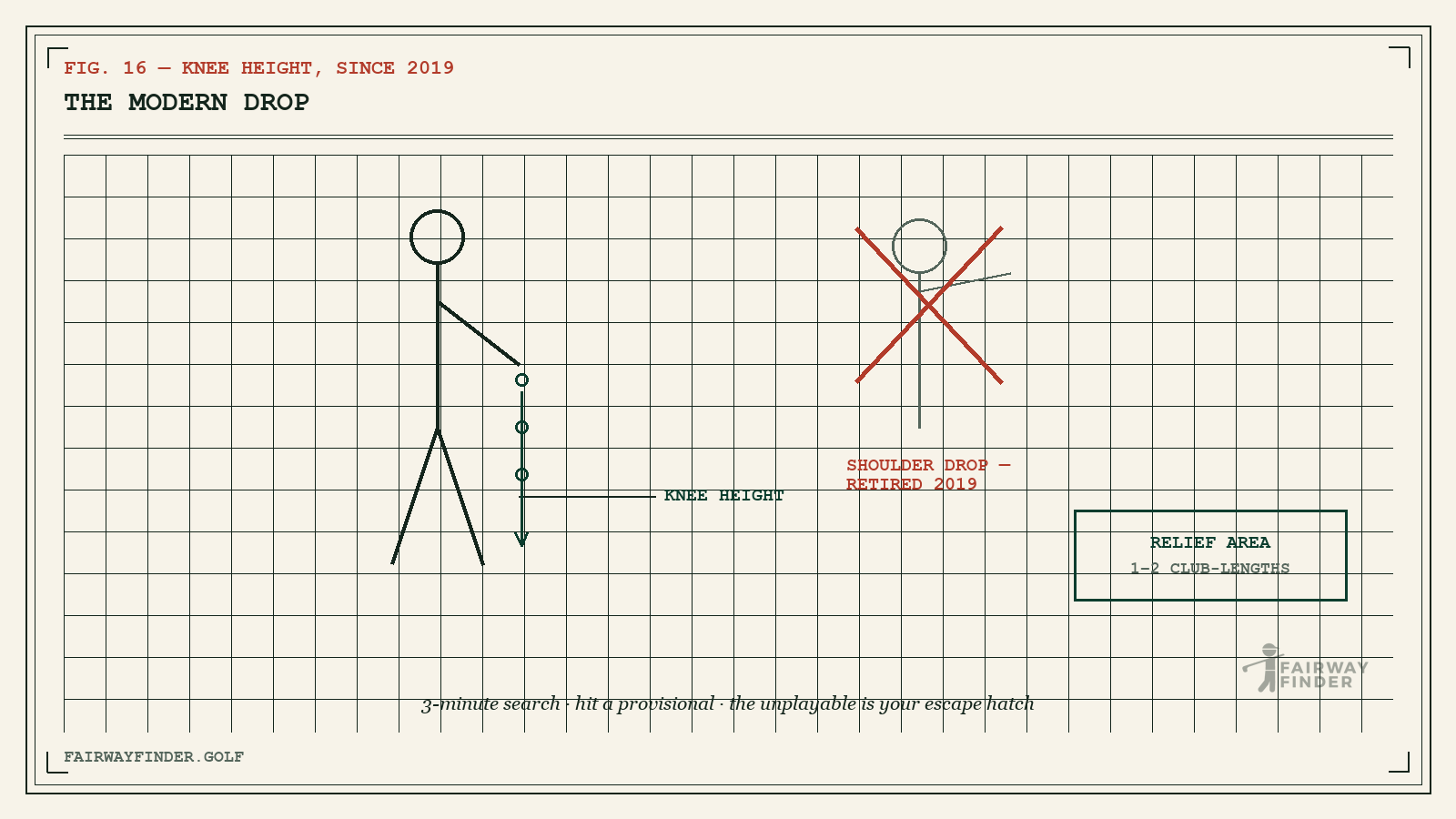
If you learned golf from an older relative, forget the shoulder-height drop — that died in 2019. The modern drop: from knee height, straight down, into the relief area. If it rolls out of the area, drop again; second time, place it. Done.
Lost Ball or Out of Bounds
The formal rule: three minutes to search (it used to be five — another outdated leftover). If it's lost or out of bounds, it's stroke and distance: add a penalty stroke and replay from where you last hit.
The part nobody tells beginners: walking back is brutal for pace, so there are two sanctioned escapes:
- Hit a provisional ball. If you suspect trouble, announce "provisional," hit a second ball before you go look, and play it if the first is gone. This is the pro move — use it.
- The local rule shortcut. Most casual courses allow (officially, since 2019) an alternative: estimate where the ball was lost, drop in the fairway near that point, and add two strokes instead of re-teeing. Faster for everyone. Ask if the course uses it; in a friendly round, just agree to it.
Penalty Areas: Red and Yellow Stakes
Modern rules renamed "water hazards" to penalty areas, and the options are simple. For the red-staked ones (the vast majority now):
- Play it as it lies if you're brave (you may even ground your club and remove loose debris now — the old prohibition is gone), or
- Take one penalty stroke and drop within two club-lengths of where the ball crossed the edge, no nearer the hole, or
- Take one penalty stroke and go back as far as you like on the line from the flag through that crossing point.
Unplayable Lie: Your Get-Out-of-Jail Card
Anywhere on the course (except a penalty area), you can declare any ball unplayable — no one's permission needed. One penalty stroke, then: two club-lengths' drop, back-on-the-line, or replay from the previous spot. In a bunker there's an extra option: drop outside the bunker on the line for two penalty strokes. Beginners dramatically underuse this rule and waste four swings hacking at a ball under a bush that one smart drop would fix.
Free Relief (No Penalty!) Situations
You drop free — nearest point of relief plus one club-length — from:
- Cart paths, sprinkler heads, and any artificial obstruction interfering with your stance or swing
- Ground under repair (usually white-lined) and casual water (puddles after rain)
- An embedded ball in the fairway or rough (plugged in its own pitch mark)
- Wrong green — you must move off it
Note what's not on the list: divots in the fairway. Cruelly, a divot is "as it lies." Every golfer hates this rule. It survives anyway.
On the Green: Almost Everything Is Legal Now
The modern rules quietly legalized most old green taboos, and this is where you'll most often hear outdated corrections:
- Leave the flagstick in while putting? Legal since 2019.
- Repair spike marks and any damage on your line? Legal.
- Accidentally move your ball or marker on the green? No penalty — just put it back.
- Ball moved by wind after you addressed it? No penalty — play it from the new spot (unless you'd already marked and replaced it; then replace it again).
If a playing partner cites a penalty for any of the above, they're playing by a rulebook that's been retired for years. Be gracious about it.
The Etiquette-Rules Overlap
Two "rules" that are actually just courtesies with teeth: playing ready golf (encouraged by the actual rulebook now — the farthest-away order is only required in formal match play) and the double-par pickup in casual play (not an official rule, but the universal custom for pace — see our full ready golf pace-of-play playbook).
What to Actually Memorize
If your brain holds only five things: knee-height drop · three-minute search, provisional when in doubt · red stakes = one stroke, drop within two club-lengths · unplayable = your escape hatch anywhere · flagstick in is fine. Everything else, you can look up between rounds — or just ask your group. Asking a rules question mid-round isn't a beginner move; it's what good golfers do. The confident scorekeeping comes next: our plain-English guide to how handicaps actually work turns your honest scores into a number you can track.
Ready to find more fairways?
The Fairway Finder driver — 43.5" control length, 460cc titanium, 11° high launch, oversize leather grip. $299 USD / CA$399 with headcover and 1-year warranty.