The golf industry would like you to believe home practice starts at a $2,000 launch monitor and ends at a $40,000 simulator room. The truth runs the other way: the most valuable home practice in golf costs almost nothing, fits in a hallway, and targets exactly the skills that transfer — while the guy with the simulator mostly plays video-game golf on it. Here's how to practice golf at home, ranked by what actually shows up on the course.
Tier 1: Putting (the Highest-ROI Carpet in Sports)
Putting is 35–40% of your strokes and 100% practicable at home. Carpet or a $30 putting mat, a target (a coin beats a cup — more on that), ten minutes:
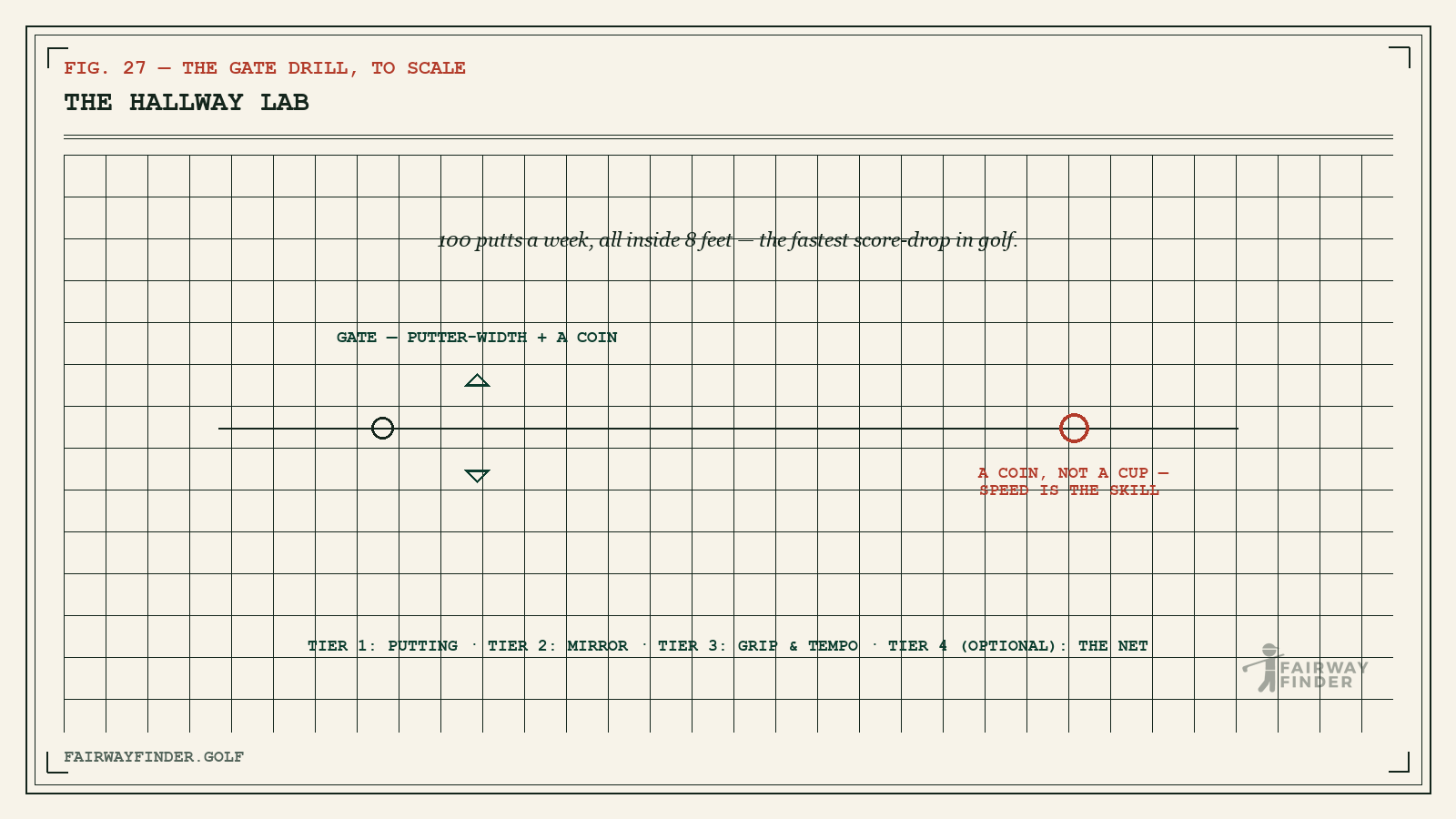
- The gate drill: two tees (or two coins) just wider than your putter head, gate at address, stroke through without touching. The classic for a reason — face control and center contact, installed in a hallway.
- Coin target, not hole: putt to a coin from 6, 8, 10 feet. A hole gives pass/fail feedback; a coin demands precise speed — and speed is the skill (short putts die at the hole; long putts finish inside the "3-foot circle" around the coin).
- The 100-putt week: 20 putts a night, five nights, all inside 8 feet. Do this for a month and watch your three-putts evaporate. No drill in golf converts faster to score.
- Eyes-closed putts: stroke, then call "long/short/left/right" before looking. Calibrates feel better than any gadget.
Tier 2: The Mirror (Positions Without a Ball)
A full-length mirror or a phone propped in slow-mo video mode is the home swing lab. No ball, no net, no lie to tell yourself:
- Setup reps: posture, ball position, alignment — 2 minutes nightly. Setup is the most copyable thing tour players do and the most drifting thing amateurs do. (Half the slice fixes in why do I slice my driver are setup fixes.)
- Slow-motion swings: 10 swings at 25% speed, checking three stations — takeaway, top, impact shape. Slow-motion rehearsal is how movements actually rewire; speed hides everything.
- The wall drill for the over-the-top move: butt against a wall, swing an imaginary club; if your hands want to drift toward the wall starting down, you've met your slice in person. Rehearse the drop-then-turn until it's boring.
- Impact bag (or an old duffel stuffed with towels, $0): slow swings INTO the bag, checking a flat lead wrist and forward shaft at "impact." The single most misunderstood position in golf, practiced safely indoors.
Tier 3: Grip, Tempo, and the Ten-Second Habits
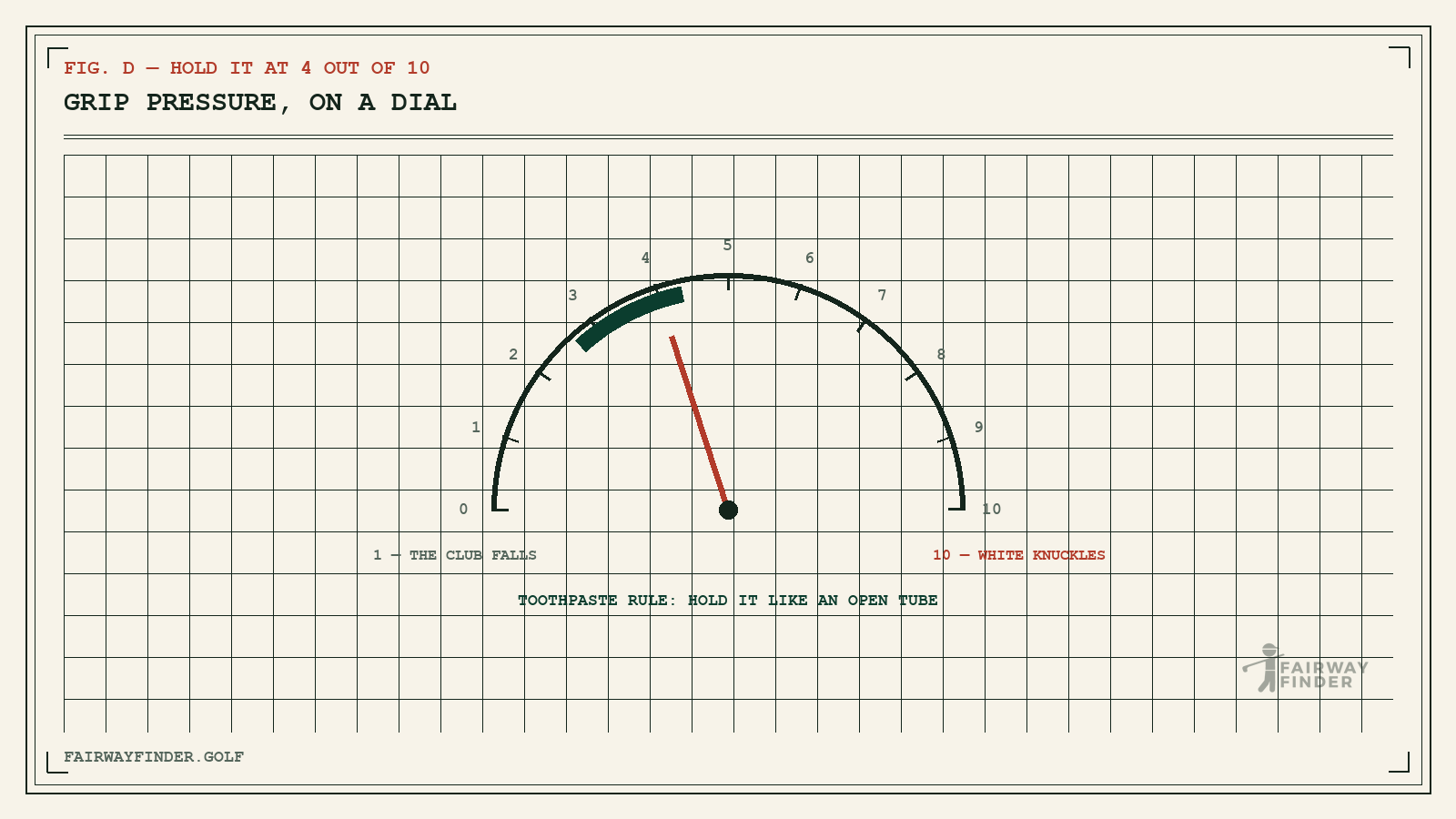
- Keep a club by the couch. Not a joke — the most effective home-practice "system" ever devised. Grip it during TV: check knuckles, re-grip, feel pressure at 4-out-of-10 instead of the on-course death squeeze (the tension story from the oversize grip guide starts at home). A hundred perfect grips a week beats one lesson a month.
- Tempo counts: swing to a "one-two-three ... one" count (3:1 backswing-to-downswing, the near-universal tour ratio) with any club, or with the classic whoosh drill — flip a club upside down and make the whoosh happen past the ball position, not behind it. Late whoosh = stored speed = the effortless-looking distance you envy.
- Lead-hand-only slow swings, 10 a day: builds the lead-side control that quiets flippy hands.
- Balance finishes: swing to a full finish and hold for a three-count, every rep, always. Balance is a skill; couches produce it.
Tier 4: Hitting Balls at Home (Optional, Honestly)
If you have garage/yard space: a practice net ($100–200) plus foam or limited-flight balls adds contact practice — useful, with one giant caveat: without flight feedback, a net grooves whatever you bring to it, including your slice, which looks perfect from six feet. Net rules: always aim at a specific spot on the net, alternate clubs, keep sessions short (30 quality swings beat 150 mindless ones), and let the mirror/video work steer what you're grooving. Real grass short-game chipping to a towel in the yard, meanwhile, is nearly as good as course practice — carry a landing towel around the lawn and you've built a short-game facility.
The launch-monitor tier ($300–500 personal units) is genuinely nice — real numbers, real accountability — but note that it's Tier 4, not Tier 1. The putting mat outranks it per dollar by a mile.
The 20-Minute Weekly Plan (Do This, Skip the Rest)
Three sessions a week, 20 minutes each, all winter (this pairs with the seasonal plan in our winter practice notes):
- Minutes 1–8: putting — gate drill, then coin targets, finish with five straight 4-footers holed.
- Minutes 9–15: mirror — setup reps, 10 slow-motion swings, wall drill if the slice is your fight.
- Minutes 16–20: grip and tempo — 20 perfect grips, 10 whoosh drills, 5 balance finishes.
That's an hour a week. Golfers who do it show up in April with a repaired grip, a calmer tempo, and a short game that never left — several strokes better having not hit a single real ball. Golfers who don't spend April re-learning March.
Home practice can't give you ball flight, wind, or the first-tee heartbeat — the course keeps its monopolies. But the skills it CAN build (putting, setup, grip, tempo) happen to be the exact ones that don't require talent, only repetition in a hallway. Come spring, warm up properly with the 10-minute routine, take the rebuilt grip to the tee, and let the winter's boring reps cash themselves in.
Ready to find more fairways?
The Fairway Finder driver — 43.5" control length, 460cc titanium, 11° high launch, oversize leather grip. $299 USD / CA$399 with headcover and 1-year warranty.